
How We Communicate

Download the WakeSafe app and Opt-In to Campus Safety Alerts
Families can receive Campus Safety Alerts by downloading the WakeSafe app and enabling notifications:
- Search for and download the WakeSafe app on your mobile device in the app store
- You will see a popup asking you to Allow Notifications. Tap Allow.

Once you have downloaded WakeSafe and enabled notifications, If a campus alert is issued, you will receive a notice on your mobile device.
How to verify you are correctly set up to receive alerts on your mobile phone
In your Settings, go to WakeSafe and ensure that you have selected Allow Notifications (we encourage you to select Immediate notifications and to allow both Sounds and Badges).
For more on campus safety
See University Police’s website about crime prevention and campus safety, and visit our Wake Alert website for more on what students should do in emergency situations.
Communications to Families
Typically, emails that are sent to students, faculty, and staff are listed on our Family News website and shared in the Daily Deac opt-in blog, unless they are of a purely administrative nature; emails sent to students are not automatically sent to families.
In compliance with the Jeanne Clery Disclosure of Campus Security Policy and Campus Crime Statistics Act (the “Clery Act”), Wake Forest University issues timely warning notices to alert the campus community of Clery Act crimes that the University determines represent a serious or continuing threat to the campus.
In addition, the University will issue an emergency notification when there is a significant emergency or dangerous situation occurring on the campus involving an immediate threat to the health or safety of students or employees (e.g., riot, bomb threat, tornado, fire, active threats, etc.). Depending on the severity, we may also send advisories about significant pending weather situations (e.g., hurricane, major snowstorm, etc.).
Notifications:
- Students, faculty, and staff will be notified via email of timely warnings, and students may also receive text messages or hear alerts on the outdoor alarm system.
- Families must download the WakeSafe app and Enable Notifications to receive campus safety alerts
- During an emergency, we strongly encourage students to text or call their parents/family members as soon as possible to report they are safe.
The Center for Global Programs and Studies (GPS) partners with crisis24/WorldAware Inc., a global risk management service, to monitor worldwide events and developments that may impact university-sponsored travelers. Alerts are provided to students about threats to health and safety in countries where students are studying.
Notifications:
- Students, faculty, and staff will be notified via email or text of threats to health and safety. Those emails typically contain information or instructions about how to stay safe or how to report that you are OK and not impacted by the incident. We strongly encourage students to text or call their parents/family members as soon as possible to report they are safe.
- Only parents/family members with students in the impacted area will be notified via email of serious incidents. If you do not hear from Wake Forest, assume your student is not known to be at risk.
If your student will be traveling abroad/away at a future date, you will not be included in this message. You can assume that we will communicate with your students if there are changes to their study abroad/away program because of safety reasons.
In the event that a student, faculty, or staff member is diagnosed with a communicable disease that would necessitate a public health response (such as mumps, bacterial meningitis, etc.), we would communicate as follows.
Notifications:
- Students, faculty, and staff will be notified via email. Depending on the illness, notification may go to all of the campus community, or just a subset (for example, students from the same residence hall if there is an identified communicable illness in that hall). Those emails typically contain information about symptoms and when to contact Deacon Health if students are concerned they might be affected. For those who are concerned, they are encouraged to check in with Deacon Health.
- Students who are considered to be at high risk because of exposure will be notified by Deacon Health and/or the Forsyth County Health Department based upon the recommendations of the Centers for Disease Control and Prevention (CDC), the North Carolina Department of Public Health, and the Division of Infectious Diseases of the Atrium Health Wake Forest Baptist Medical Center. Potential screening and treatment will be offered and administered as indicated to prevent subsequent cases in at-risk students. If a student does not receive an individual email, text message, or phone call requesting a screening from Deacon Health and/or the Forsyth County Health Department, the student is not known to be at risk.
- Parents/family members may be notified via email of a communicable disease on campus. Generally, we would not notify families of diseases such as influenza or norovirus, but we would notify them when there are cases of bacterial meningitis, or mumps, or other infectious diseases that pose a significant threat to others on campus. However, please remember that unless your student has received an individual email, text message, or phone call requesting a screening from Deacon Health and/or the Forsyth County Health Department, your student is not known to be at risk.
North Carolina law generally prohibits healthcare providers from disclosing medical information about individuals who are 18 years of age and older to family and friends without permission of the individual. However, if a student experiences a medical emergency or life-threatening health concern, the University has a robust set of on-call personnel to coordinate response to these incidents, and informing families is a high priority.
In accordance with Wake Forest University’s Student Conduct Code and as permitted by FERPA (Family Educational Rights and Privacy Act), parents or family members may be contacted by email and/or phone if their student is found in violation of its alcohol or other drug policies. Parents or family members may be contacted to discuss the challenges students are navigating.
If your student is experiencing a serious mental health issue or a serious threat to their wellbeing, the university can utilize various interventions based on the needs of the individual concerns. Due to North Carolina law, mental health providers on campus are not able to communicate about the clinical treatment of clients who are 18 years of age and older without the written permission of the client/student. This limitation also applies to confirming or denying whether a student has sought care with a university mental health provider. Mental health providers regularly invite students to sign appropriate documentation so that communication with parents/families can occur as needed. In addition, parents/family members may be notified via phone (or email if we have no phone number for the family) when it is determined that there is a serious concern for the student’s health and/or safety.
When a Wake Forest undergraduate student dies, we alert the campus community and parents/family members as follows:
- Notifications:
- Wake Forest will make every attempt to notify students, faculty, and staff closest to a deceased student before a larger notice is distributed. Other students, faculty, and staff are typically notified via email. Those emails typically contain information about how to access support in their grieving. Please note that we will not disclose the cause of death of a member of our campus community without the permission of the deceased’s family.
- As with all campus-wide emails, we will share it in the Daily Deac blog so that families can be aware that their student might need support if they are grieving.
In the event of a serious issue with a fraternity/sorority chapter or student organization, the following typically happens:
Notifications:
- Students in that organization are notified of the incident and the status of the chapter or organization. Those emails typically contain information about next steps if it is a conduct issue.
- Parents/family members/alumni/ae of a chapter or organization will be notified after an incident regarding substantial risk or harm to health and safety and/or at the conclusion of a student conduct proceeding resulting in a chapter or organization’s deferred suspension or suspension. In certain circumstances, parents and families may be notified prior to a student conduct proceeding. The factors considered in making the decision whether to notify families include: severity of risk or harm to students or community, the public nature of an incident, and prior student conduct record of the chapter.
If you have a particular concern about a student (your student, or their friend, roommate, etc.) and want assistance in supporting your student or directing them to resources on campus, contact any of the following offices:
Emergency Response/24-7 (year-round)
- University Police – 336.758.5911 for the kinds of emergencies where you would normally call 911 (e.g., immediate life and safety concerns)
Non-Emergency Response for other concerns
- we.wfu.edu or 336-758-CARE (2273) is a service that ensures someone will always be available (i.e., 24/7 M-F, weekends and university holidays) to provide caring and thoughtful consultation services for Wake Forest students in need of mental health assistance or support
Other Resources
- SAFE Office Helpline for interpersonal violence support (24/7 when school is in session) – 336.758.5285
- Report a Crime
- Hazing Hotline – 336.758.HAZE (4293)
- Bias Reporting
- The Wake Parents & Families e-newsletter is automatically sent out mid-month by email to all parents and families for whom we have an email address (check your spam/junk filter to ensure your Internet Service Provider didn’t route it there).
- The Daily Deac is our opt-in daily blog that shares important news, offers advice about supporting your students, and covers a variety of WFU activities and events to help you get a sense of campus life. Subscribe and the blog will be emailed to your inbox around 5 pm each weekday (check your spam/junk filter).
Subscribe to the Daily Deac
- Invitations to events: Parents and families may receive invitations to Wake Forest events on campus or in their home areas. Often invitations come from what we call WAKECommunities (i.e., regional clubs). Sometimes event invitations are marketed by the Office of Alumni Engagement, but they are open to all Wake Foresters, no matter their affiliation. Please know that even if an email says the word “alumni,” if you received it, you were invited too!
Parent-Run Social Media Groups
Many Wake Forest parents connect with one another through independently run social media groups. These communities can be a helpful way to share experiences and advice. Please note that these groups are not affiliated with or monitored by the University, and information shared there may not always reflect current university policies or practices.
For the most accurate, up-to-date information, we encourage you to rely on official university communications and websites (e.g., wfu.edu, parents.wfu.edu, etc.) as well as University social media sites. You can also follow our public Facebook page for parents—no membership required—at Facebook.com/WFUParents:
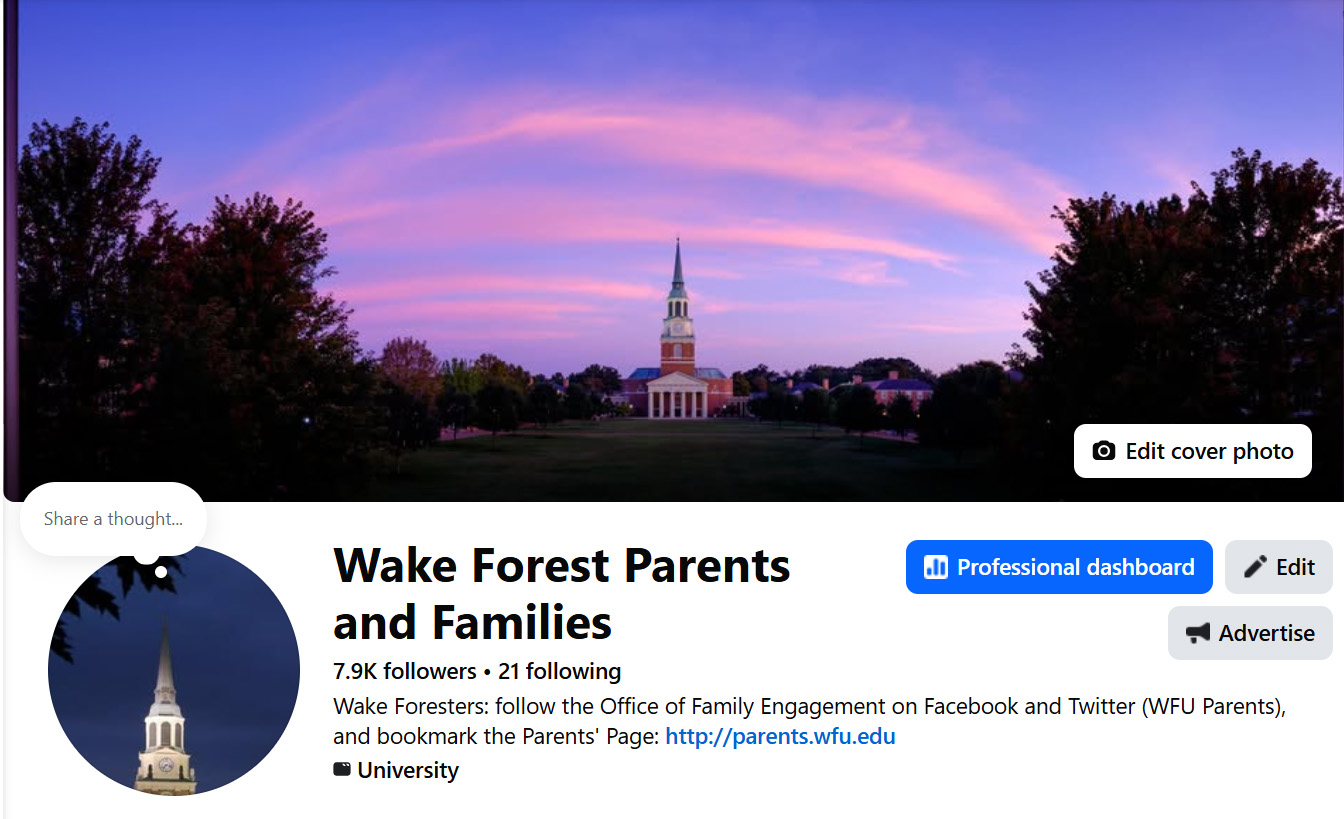
If you have a question or concern, please be in touch with the University directly at ; our team is always happy to help.
How We Partner with Families
Wake Forest believes parents and family members can be our best partners in ensuring their students’ success. Parents and families are incredibly important sources of support and care.
Wake Forest seeks to:
- Engage parents and families in ways that are developmentally appropriate and allow students to make independent decisions as they enter adulthood.
- Create an environment where students are given freedom and autonomy to solve their own problems, experience struggle, difficulty, and even failure.
- Help students develop problem-solving skills and the resilience they need to be independent, successful adults.
Wake Forest believes students should:
- Be encouraged to make their own decisions about their Wake Forest experience (e.g., class registration, choice of a major, co-curricular activities, managing their finances, personal wellbeing, etc.). Our Navigating Student and Family Roles page offers examples of student responsibilities vs. family responsibilities.
- Learn how to advocate for themselves and create positive relationships with academic departments and administrative offices. Students should be the one to contact campus offices when they need assistance.
- Participate in a collegiate environment where mistakes can be seen as opportunities for learning and growth.
- Have access to helping resources on campus that attend to their holistic wellbeing.
- Be afforded the privacy that is granted to them under FERPA (the Family Educational Rights and Privacy Act): University employees are generally not permitted to share information about the student’s academic performance or other information without the student’s permission.
Stop, Drop, and Roll
As you consider your student’s Wake Forest experience, we encourage parents and families to use the Stop, Drop, and Roll method – a philosophy that allows students to achieve each of the goals outlined on this webpage. If your student tells you about a problem or a frustration they have, a decision they need to make, or a routine task they need to complete, we encourage parents and families to:
- Stop, and take a deep breath
- Drop the urge to solve the problem for them or provide instructions on how to resolve the issue/make the decision/handle the task. Instead, be curious and respond with additional questions: What might you do? What are you considering? Are there any offices on campus who might be able to help you? Have you asked a staff member, faculty member, or RA for help?
- Roll with whatever solution your student comes up with on their own, even if it is different from what you might have done.
Have questions? Contact us.
Betsy Chapman, Ph.D. (’92, MA ’94)
- Executive Director of Family Communications
- 336.758.4845